|
|
 |
|
|
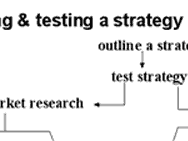 Ideally no campaign should be started until you have tested your strategy.
In reality campaigns often 'just grow' and the opportunity to properly test them never arises.
I recommend testing a strategy with two types of research - qualitative research to investigate language, and 'political' research to
investigate obstacles, decision-making, attitudes of key individuals, potential allies and opponents.
[Click on the image to see how.]
Qualitative research should not be confused with quantitative opinion research conducted by groups such as Gallup, NOP or MORI
(MORI probably has the largest amount of specifically environmental 'tracking'
and attitudinal research of this kind, and Environics probably conducts the best global surveys).
Quantitative or 'polling' research tells you how many people think something. Qualitative research tells you why they think something.
The best known (but not the only) type of qualitative research is 'focus groups' - ie mediated discussion groups run by a skilled mediator.
This research is essential for getting beneath the skin of 'issues' and past the initial responses people will give based on trying
to 'be helpful' to the questioner, what they've been 'told' to think about it in the press, or the influence of the group.
In my experience good qualitative research (which takes time and hence money) invariably throws up major challenges to any campaigner's
assumptions about what messages or arguments are 'effective'.
An example of qualitative research: Greenpeace discovered that (especially for women) the most motivating consequence of destruction of the
ozone layer was not the usual issues mentioned in policy debates (eg skin cancer incidence, damage to fisheries, Antarctic wildlife, even whales) but
the idea that it could threaten holidays. If ozone destroying chemicals made it dangerous to spend two weeks in the sun, then they ought to be banned.
Another example: if you ask men why they buy fish fingers they will say 'because' they are convenient, healthy, covered in golden batter,
tasty etc. But the real reason - which takes longer to get at - is that it enables them to be like children again by sitting down with
their kids.
You can do your own research of course but like diagnosing your own illness or piloting your own aircraft, it is usually better to hire a professional,
or get their help. A company with extensive experience of qualitative research on environmental issues is KSBR at www.ksbr.co.uk.
Most campaign groups ought to be able to conduct their own 'political' research. It is mostly a question of gaining access (often this just
involves a phone call and a visit) to the people who know, and following up every lead. A huge 'public affairs' industry exists to help
businesses do such research but public interest organisations ought, with common sense, to be able to use goodwill among politicians, business people,
journalists and officials to find out what they need to know. But don't take what anyone tells you as gospel - always try to check it
yourself, and beware the old journalistic saying "This story is too good to check" (attributed to Richard Ingrams, then Editor of Private Eye).
|
|
|
|
 Testing a strategy