 |
Be Multi-Dimensional
A campaign has more chance of success if it communicates in many dimensions. Ideally each of the points on a critical path should register in each dimension.
In terms of argument and the research needed for it, this means being able to make a case in each. In terms of perception, the campaign to be visible in each dimension. Ask yourself what the picture would be, what you would be doing at each point (the photo test). For example (diagram below) there might be scientific, technical, political, economic and emotional dimensions, and maybe ethical, moral, historical, cultural or others.
Atlantic Frontier
The Greenpeace Atlantic Frontier campaign1 was deliberately designed to communicate in a number of dimensions.
- Scientific/logical
It opposed development of more fossil fuel resources, intervening at the point of political responsibility (licensing development), based on the 'carbon logic'2 which shows that burning available oil, coal and gas in the atmosphere would cause catastrophic climate change (so don't develop new reserves).
- Political
It drew a line-in-the sand at the Atlantic Frontier oil field of West Scotland, and at specific development blocks within that. It contrasted UK climate rhetoric with fossil fuel in practice. It planned to make the contrast Tony Blair's oil policy at home with his climate rhetoric at the UN3.
- Ethical-political
It challenged the UK's right to claim the oil beneath the Atlantic based on its claim to the remote islet of Rockall - and likewise that of Iceland, Ireland and Denmark, by occupying the rock for a second time. It called for establishment of a World Park.
- Ethical-emotional
It communicated (with surveys and information) the wildlife of St Kilda, and the Rockall Trough, known as a 'motorway' for migrating whales. It also raised the case against destructive deep sea fishing to support the World Park set-aside case.
- Legal-ethical
It challenged4 oil development in court on grounds of damage to ancient cold water corals and other species (resulting in a successful ruling to greatly extend application of the EU Habitats Directive).
- Economic-political
- It argued for conversion of oil fabrication yards to wave-and wind-power manufacturing (with some success).
- It challenged BP over its internal allocation of funds to renewables as opposed to new oil, for example with shareholder actions.
The campaign was also designed5 to take place in a national theatre of great romance, mystery and physical security and drama - an inspirational setting of epic scale, making it more natural to raise fundamental questions about the future direction of society. This also helped increase the possibility of making some sort of progress because the immediate target was a 'tough nut' (see page ), on the grounds that if you wanted to initiate a campaign to stop littering then the easiest place to start might be a cathedral.
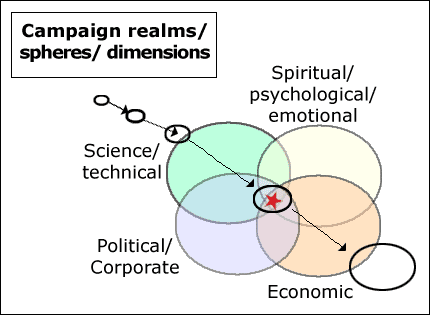
Critical path passing through multiple dimensions. See the Atlantic Frontier example.

11997-2000 - see website http://archive.greenpeace.org/climate/ and The Turning of the Spar, Chris Rose pub Greenpeace 1998, and 1999-2000 campaign at www.greenpeace.org.uk
2Bill Hare, Fossil Fuels and Climate Protection: The Carbon Logic, Greenpeace 1997 ISBN 90-73361-41-6
3At the June 1997 UN General Assembly Special Session on the environment - unfortunately internal differences in Greenpeace meant this didn't happen, robbing the campaign of some political salience
4with other NGOs
5The campaign suffered several shortcomings. Public engagement mechanisms never developed very effectively, and it was ended before it became widely known in the UK outside Scotland. Among its successes, the campaign put the term 'fossil fuels' into the political dictionary used in discussing climate change, for the first time, and led to significantly increased political backing for renewables in Scotland.
|
|